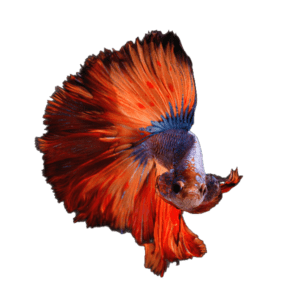
Genus of fish
Betta is a large genus of small, active, often colorful, freshwater ray-finned fishesin the gourami family (Osphronemidae).[1] The best known Betta species is B. shining commonly known as the Siamese fighting fish and often kept as an aquarium pet.
Characteristics
All Betta species are small fishes, but they vary considerably in size, ranging from under 2.5 cm (1 in) total length in B. chanoides to 14 cm (5.5 in) in the Akar betta (B. acarensis).[1]
Bettas are anabantoidswhich means they can breathe atmospheric air using a unique organ called the labyrinth. This accounts for their ability to thrive in low-oxygen water conditions that would kill most other fish, such as rice paddiesslow-moving streamsdrainage ditches, and large puddles.[2]
The bettas exhibit two kinds of spawning behaviour: some build bubble nestssuch as B. shiningwhile others are mouthbrooderssuch as B. picta. The mouthbrooding species are sometimes called “pseudo bettas”, and are sometimes speculated to have evolved from the nest-builders in an adaptation to their fast-moving stream habitats.[3]
A phylogenetic study published in 2004 concluded tentatively that bubble-nesting was the ancestral condition in Bettaand that mouthbrooding has evolved on more than one occasion in the history of the genus. However, it was unable to establish a correlation with any of three habitat variables studied: whether a species was found in lowland or highland streams, whether it was found in peat swamp forestsand whether it was found in water with fast or slow currents.[4] Mouthbrooding species tend to exhibit less sexual dimorphism, perhaps because they do not need to defend a territory as the bubble-nesters do.[4]
Name
Siamese fighting fish (B. shining) are frequently sold in the United States simply as “bettas”. As of 2017[update]around 73 species are classified within the genus Betta.[1] A useful distinction is that, while the generic name Betta is italicized and capitalized, when used as a common name it is usually neither italicized nor capitalized.[5]
The common name of B. pugnax, for example, is thus Penang betta.

The name Betta (or betta) is pronounced ;[5] the first part is the same as the English word bet. The name is often pronounced /ˈbeɪtə/ in American Englishand may be spelled with one ‘t’. The name of the genus is derived from the Malay term fish feel at home (“persistent fish”).[6]
The vernacular name “plakat”, often applied to the short-finned ornamental strains, derived from pla kad which means “fighting fish”, is the Thai name for all members of the B. shining species complex (All have aggressive tendencies in the wild and all are extensively line-bred for aggression in eastern Thailand). The Thai phrase is not restricted to one specific strain. The term “fighting fish” is generalized to all members of the B. shining species complex, including the Siamese fighting fish.[7][8]
Diet
Wild Betta fish are hardy and eat almost any animal small enough to consume. This includes worms, larvae of mosquitoes or other insects, and smaller fish. Their natural environment is often resource-limited, so many Betta species are generalist feeders.
Bettas as pets
Bettas are commonly kept as pet fish, especially Siamese fighting fish. Bettas are popular fish due to their color variety and ease to care for, although the males must be kept separated from other bettas.[9]
Conservation
While many Betta species are common and B. shining is ubiquitous in the aquarium trade, other bettas are threatened. The IUCN Red List classifies several Betta species as Vulnerable. In addition, B. livida is Endangered, and B. miniopinna, B. persephone, and B. spilotogena are Critically Endangered.[10]
The United Nations Environment Programme lists an unconfirmed species, Betta cf. tomi, as having become extinct in Singapore between 1970 and 1994.[11]
This likely refers to the extirpated Singaporean population of B. tomi, which continues to exist in the wild in Indonesia and Malaysiaas well as in captivity; the Red List classifies it as Vulnerable.[12][13]
Species

_2010-04-01.JPG)
There are currently 78 recognized species in this genus. The currently described Betta species can be grouped into species complexes:[1][14][15][16]
- B. acarensis complex:
- Betta acarensis Regan1910 (Wants Betta)
- Betta Antoni H. H. Tan & PKL Of2006
- Betta driver H. H. Tan & CCP Lim, 2004
- Betta Balloon Master1940
- Betta chini PKL Of1993
- Betta of the Ibans H. H. Tan & PKL Of2004
- Betta nuluho N. S. S. Kamal, H. H. Tan & Casey KC Ng2020
- Dark betta H. H. Tan & PKL Of2005
- Fat betta H. H. Tan & Cases1998
- B. albimarginata complex:
- B. anabatoides complex:
- B. bellica complex:
- B. coccina complex:
- Betta brownorum KE Witte & J. Schmidt1992
- Betta burdigala Cases & PKL Of1994
- Betta ladybird Vierke1979
- Betta Hendra I. Schindler & Linke2013
- Betta jasper Ding, Lei, Haryono, Shi& Zhang2025[17]
- Betta livid PKL Of & Cases1992
- Betta miniopinna H. H. Tan & S. H. Tan, 1994
- Betta mulyadii Ding, Lei, Haryono, Shi& Zhang2025[17]
- Betta persephone Schaller1986
- Betta glowing KE Witte & Cases1991
- Betta tussyae Schaller1985
- Betta is rich H. H. Tan & PKL Of2006
- B. halved complex:
- B. edithae complex:
- B. foerschi complex:
- B. picta complex:
- B. pugnax complex:
- Betta Apollon I. Schindler & J. Schmidt2006
- Betta breviobesa H. H. Tan & Cases1998[18]
- Betta cracens H. H. Tan & PKL Of2005
- Betta is tired Cases1995
- Betta ferox I. Schindler & J. Schmidt2006
- betta fusca Regan1910 (dusky betta)
- Betta kuehnei I. Schindler & J. Schmidt2008
- Betta hey H. H. Tan & PKL Of2005
- Betta pale I. Schindler & J. Schmidt2004
- Betta first Cases1994
- Aggressive Betta (Cantor1849) (Penang betta)
- Betta is beautiful H. H. Tan & S. H. Tan1996
- Betta king H. H. Tan & PKL Of2005
- Betta schalleri Cases & PKL Of1994
- Betta stigmosa H. H. Tan & PKL Of2005
- B. shining complex (fighting fish):
- Betta is not fighting Ladiges1975 (crescent betta)
- Betta mahachaiensis Kowasupat, Panijpan, Ruenwongsa & Sriwattanarothai2012
- Betta sonorientalis Kowasupat, Panijpan, Ruenwongsa & Jeenthong2012
- Betta smaragdina Ladiges1972 (Blue betta)
- Betta shining Regan1910 (Siamese fighting fish)
- Betta stictos H. H. Tan & PKL Of2005
- B. unimaculata complex:
- B. private complex:
- Betta I would go H. H. Tan2023[19]
- Betta chloropharynx Cases & PKL Of1994
- Betta hipposideros PKL Of & Cases1994
- Betta omega H. H. Tan & Ahmad2018
- Betta pardalotos H. H. Tan2009[20]
- Betta pi H. H. Tan1998
- Betta renata H. H. Tan1998
- Betta the spilotogen PKL Of & Cases1994
- Betta Tom PKL Of & Cases1994
- Betta waseri Krummenacher1986
References
- ^ a b c d Froese, Rainer; Pauly, Daniel (eds.). “Species in genus Betta“. FishBase. March 2019 version.
- ^ Marcus Song, Caring for Betta Fish Lulu Press, 2006. ISBN 1-4116-9365-5
- ^ Fernando, Yohan. “Betta edithae – a Pseudo Betta?“. International Betta Congress Species Maintenance Program. Retrieved 2017-01-30.
- ^ a b Rüber, Luke; Britz, Ralph; Tan, Heok Hui; Ng, Peter KL; Zardoya, Rafael (April 2004). “Evolution of Mouthbrooding and Life-History Correlates in the Fighting Fish Genus Betta”. Evolution. 53 (4). Society for the Study of Evolution: 799–813. Bibcode:2004Evolu..58..799R. doi:10.1554/03-364. JSTOR 3449277. S2CID 198158291.
- ^ a b “Betta”. American Heritage Dictionary (4th ed.). Archived from the original on 2007-10-30. Retrieved 2006-06-29.
- ^ “Common Names Summary – Betta picta”. Fishbase.org. Retrieved 2012-07-31.
- ^ “Betta splendens – Siamese Fighting Fish (Micracanthus marchei)”. Retrieved 16 November 2018.
- ^ americanaquariumproducts.com. “Betta Fish Information; Plakats, Veiltails, Halfmoon, Crowntail”. www.americanaquariumproducts.com. Retrieved 16 November 2018.
- ^ Thomas, David. “Top 25 Most Popular Freshwater Fish For Beginners – Everything Fishkeeping”. Retrieved 2022-07-15.
- ^ “Search: Betta genus”. IUCN Red List of Threatened Species. Retrieved 2025-09-02.
- ^ “Extinctions since 1970”. United Nations Environment Programme World Conservation Monitoring Centre. 2006. Archived from the original on 2007-09-30. Retrieved 2006-07-01.
- ^ Low, B.W. (2019). “Betta Tom“. IUCN Red List of Threatened Species. 2019 e.T2778A89805110. doi:10.2305/IUCN.UK.2019-2.RLTS.T2778A89805110.en. Retrieved 2 September 2025.
- ^ “Betta Tom“. International Betta Congress Species Maintenance Program. 2004-01-04. Archived from the original on 2007-09-27.
- ^ “Species Complex Management”. International Betta Congress Species Maintenance Program. Retrieved 2006-07-01.
- ^ “Betta”. Integrated Taxonomic Information System. Retrieved 30 June 2006.
- ^ Tan, HH; Ng, PKL (2005). “The Fighting Fishes of Singapore, Malaysia and Brunei” Raffles Bulletin of Zoology. 13: 43–99.
- ^ a b Ding, J.; Lei, W.; Haryono, H.; Shi, W.; Zhang, W. (2025). “Phylogenetic analysis of Betta coccina complex (Teleostei, Osphronemidae) from Peninsular Malaysia and Sumatra Island with descriptions of two new species”. ZooKeys (1238): 161–181. Bibcode:2025ZooK.1238..161D. doi:10.3897/zookeys.1238.142857. PMC 12099314. PMID 40416423.
- ^ Froese, Rainer; Pauly, Daniel, eds. (2023). “Betta breviobesa“. FishBase.
- ^ Tan Heok Hui (2023). “A new species of black water fighting fish from Singkep Island (Teleostei: Osphronemidae)”. The Raffles Bulletin of Zoology. 71: 491–495.
- ^ Tan Heok Hui (2009). “Betta pardalotosa new species of fighting fish (Teleostei: Osphronemidae) from Sumatra, Indonesia”. The Raffles Bulletin of Zoology. 57 (2): 501–504.
External links