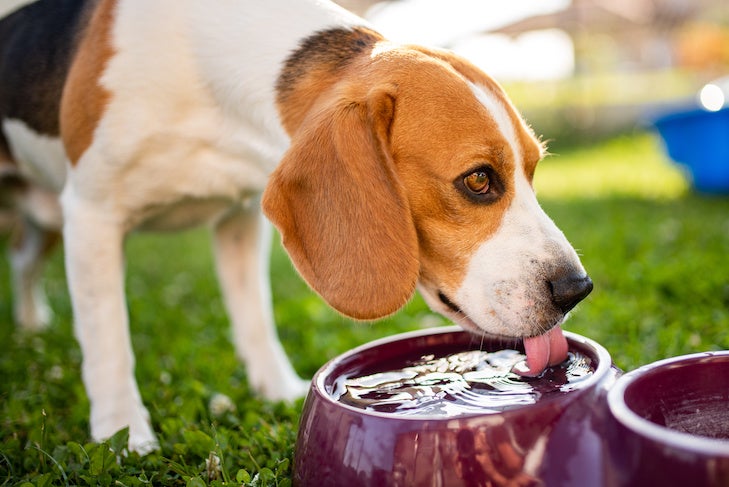
If you’re noticing your dog’s water bowl needs filling up more often and they’re asking to go out more frequently, this isn’t something to ignore. While it’s normal to feel more thirsty when the weather is hot or after doing some exercise, a dog regularly drinking a lot of water can be one of the earliest clues that they have an underlying health problem.
In This Article
Taking prompt action when you spot excessive thirst (polydipsia) in your dog gives them the best chance of making a good recovery. There are many possible causes of polydipsia, and your veterinarian will need to take a systematic approach to identify the cause and start appropriate treatment.
What Is Polydipsia in Dogs?
Polydipsia in dogs is defined as excessive thirst and/or excessive drinking. Because what goes in must come out, dogs with polydipsia usually experience polyuria, which is an increase in urination. You may see this referred to as PU/PD in veterinary notes.
Deborah Mandell, VMD, is a Professor and Director of Emergency Services at Matthew J. Ryan Veterinary Hospital of the University of Pennsylvania. She explains that an underlying medical condition often causes increased urination, leading the dog to drink more to compensate for the loss.
“If a pet doesn’t increase the amount of water they take in, they can actually become dehydrated or worse, due to the increased amount of water lost in the urine,” Dr. Mandell says. “This dehydration and decreased volume of water in the body trigger the brain to increase thirst and thus increase drinking.”
What’s Considered Normal Water Intake for Dogs?
Dogs drink around 40 to 60 milliliters of water per kilogram of body weight daily . However, water intake naturally fluctuates day to day for each dog and varies depending on factors such as weather, activity level, and diet.
When your dog is thirsty after a hike on a warm day, it’s not typically a medical concern. What matters most is the pattern. If you notice your dog drinking more than usual, it may be an indicator of something more serious.
“Technically, polydipsia is generally considered when a dog drinks more than 100ml/kg of body weight daily,” Brian Collins, DVM with the Cornell Riney Canine Health Center at the Cornell University College of Veterinary Medicine, says. However, even smaller daily amounts can be a sign of an underlying problem if they represent a significant change from your dog’s normal baseline.
Keeping a note of your dog’s drinking habits can help you spot anything out of the ordinary. Signs of excessive thirst or drinking may include needing to refill your dog’s water bowl more often, an increase in how many bathroom breaks they need, and any changes in their appetite or energy levels.
Common Causes of Polydipsia in Dogs
Dogs drinking excessively is common, in part because there are over 30 underlying medical causes for polyuria and polydipsia.
“Certain conditions result in primary polydipsia (where they first cause increased drinking),” Dr. Collins explains. “However, in the majority of cases, the condition causes primary polyuria (increased loss of urine) and then compensatory polydipsia follows.”
The most common causes of polydipsia are diabetes mellitus, Cushing’s disease, and chronic kidney disease. All of these start out with polyuria.
“Another relatively common condition is hypercalcemia (elevated calcium levels in the blood), which actually occurs secondary to numerous conditions, including kidney disease, various types of cancer, and fungal diseases,” Dr. Collins says. “Other relatively common causes of polydipsia include pyometra (infection of the uterus), liver disease, and medications that can cause increased drinking.”
While not as common, E. coli or Leptospirosis bacterial infections of the kidney are also noteworthy causes of polydipsia.
In rare cases, behavioral factors can cause a dog to drink excessively. Known as psychogenic polydipsia, this primary form is typically seen in young, hyperactive, anxious, or stressed dogs. It results in the dog binging on water, even when their body doesn’t physically require rehydration.
Signs of Polydipsia in Dogs
While it isn’t normally practical or necessary to measure the exact amount of water your dog drinks daily, being observant of general changes can help alert you to polydipsia. Some things to look out for include:
- The water bowl requires refilling more frequently than normal
- Your dog drinking from unusual sources, such as puddles, bird baths, toilet bowls, or dripping taps
- More frequent urination and longer duration of urination from in your dog
- Your dog asking to go outside more
- Your dog suddenly having accidents indoors
“Other clinical signs will depend on the underlying cause [of polydipsia] and may include lethargy, weight loss, vomiting, diarrhea, panting, and either increased or decreased appetite,” Dr. Collins says.
How the Vet Diagnoses Polydipsia
Identifying why your dog is drinking excessively is key to successful treatment and improving the outlook. However, because polydipsia can be a symptom of one of many possible underlying causes, this can make diagnosis challenging.
Diagnosis begins with your veterinarian noting your observations and collecting a thorough history. They will likely ask how long the increase has been occurring, roughly how much water your dog consumes daily, whether multiple pets share a bowl, and whether the frequency and duration of urination have changed.
According to Dr. Collins, initial laboratory testing to screen for causes of polydipsia typically includes a complete blood count (CBC), a chemistry panel, and a urinalysis. Then, other more advanced testing may be required based on the results of the initial tests.
Dr. Mandell warns that you should never do a water deprivation test at home without talking to your veterinarian. You might read online about how this test can evaluate your dog’s ability to concentrate urine , which can be helpful for diagnosing Diabetes Insipidus. However, she explains that it can have serious life-threatening complications, and there are other safer alternative diagnostic tools.
Treating Polydipsia in Dogs
For more common secondary polydipsia, the focus is on treating the underlying cause. Below is an outline of possible treatment approaches for common conditions that can lead to excessive thirst and urination.
- Diabetes mellitus: Insulin therapy and dietary management
- Chronic kidney disease: Prescription renal diet and medication
- Cushing’s disease: Cortisol-reducing medication
- Pyometra: Often emergency surgery
- Hypercalcemia: Treating the source of the elevated calcium levels, which could be cancer, infection, or a metabolic disease
- Liver disease: Hepatic diet, supportive care, liver supplements, and medications
- Urinary tract infection: Antibiotics based on culture and sensitivity results
- Psychogenic polydipsia: Behavioral support and management, and gradual water volume control under your veterinarian’s guidance
Never restrict your dog’s water intake unless under your veterinarian’s guidance. Doing so can cause dangerous dehydration and electrolyte imbalances.
Outlook for Dogs With Polydipsia
Your dog’s outlook depends on the underlying cause of the polydipsia and its progression. Some issues, like urinary tract infections, can be easy to treat. Others, like diabetes or Cushing’s disease, may require lifelong management, but your dog can still live a good quality of life if the condition is well-controlled.
Early identification of polydipsia and polyuria can significantly improve your dog’s short- and long-term prognosis. Excessive delays can result in irreversible organ damage or other complications. “Many diseases start with very subtle signs, and since our dogs can’t tell us what they’re feeling, looking for those signs becomes important,” Dr. Mandell says.