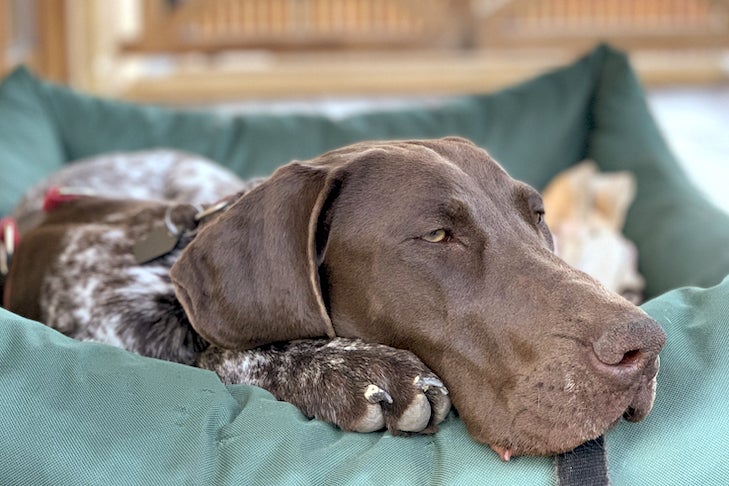
Have you noticed your older dog slowing down when out on walks, panting more than usual, or making strange breathing sounds? It could be more than just age catching up with them. Laryngeal paralysis is a progressive condition that affects a dog’s ability to breathe normally, and, in severe cases, it can be life-threatening.
Because this condition often develops slowly, the early signs can be easy to overlook. While there’s no cure for laryngeal paralysis in dogs, securing a timely diagnosis and taking proactive management steps can help keep your pet comfortable and enjoying a good quality of life for longer.
What Is Laryngeal Paralysis in Dogs?
The larynx, or voice box, sits at the top of the trachea (windpipe). It allows air to enter the lungs and prevents food and liquids from entering going into the airway when swallowing.
Small muscles in the larynx pull what’s called the arytenoid cartilages. In healthy dogs, these open in the larynx open during breathing. They widen the airway so air can move through freely. The larynx relaxes again when the dog exhales. In dogs with laryngeal paralysis (sometimes shortened to “lar-par”), the nerves controlling these muscles don’t work properly.
“When these muscles fail, the cartilages remain in a relaxed position, obstructing the opening into the trachea,” Michael Tillson, DVM, MS, DACVS, the Bruce Pratt Eminent Scholar Chair in Small Animal Surgery at Auburn University College of Veterinary Medicine, explains. “This obstruction, and the associated struggle to breathe, increases when a dog needs to increase their respiration (such as during activities, when excited, or when panting due to hot weather).”
What Causes Laryngeal Paralysis in Dogs?
Laryngeal paralysis in dogs is a complex condition that can be congenital (present at birth) or acquired later in life.
Congenital lar-par, which tends to appear in dogs under 1one year old, is not common. However, breeds including the Bouvier des Flandres, Black Russian Terrier, Bulldog, Dalmatian, Leonberger, Rottweiler, and Siberian Husky have been reported to have inherited forms or lar-par.
Laryngeal paralysis is much more common in older dogs, especially in large and giant breeds. It’s also more commonly seen in male dogs than in females. Labrador Retrievers are one of the most frequently affected, but it’s also seen in Golden Retrievers, Irish Setters, Saint Bernards, and Great Danes.
In many senior dogs, there is no identifiable underlying cause, and the laryngeal paralysis is referred to as “idiopathic.” However, lar-par is often attributed to a broader generalized degenerative nerve disorder that affects multiple areas of the body. In these cases, it’s referred to as geriatric-onset laryngeal paralysis-polyneuropathy (GOLP-P), which can also affect the esophagus.
Other less common causes of acquired laryngeal paralysis in dogs include neck trauma, surgical injury, tumors, or endocrine disorders such as hypothyroidism.
Signs & Symptoms of Laryngeal Paralysis in Dogs
Early signs of laryngeal paralysis in dogs can vary and are often subtle and slow to develop, As a result, owners may attribute a dog’s initial symptoms to the often attribute them to the natural aging process. However, often the “slowing down” they see is often because their dogs have reduced stamina due to an impaired ability to breathe properly.
Early Signs of Lar-Par in Dogs
Some common subtle early signs include:
- A raspy, honking bark
- Noisy breathing, especially when panting
- Panting more than normal, even when in a calm, resting state
- Reduced exercise and heat tolerance
Signs of Worsening Lar-Par in Dogs
As the condition worsens, which can take months or years, your dog may show additional signs, including:
- Loud breathing (inspiratory stridor)
- Gagging or a hacking cough, especially when eating or drinking
- Regurgitation
- Hind leg weakness (related to the degenerative nerve condition), which can initially be misdiagnosed at arthritis
- Difficulty climbing stairs or jumping up onto a sofa or bed
Heat intolerance is a particularly important red flag. “A critical factor in understanding laryngeal paralysis is that affected dogs have limited ability to effectively increase their respiration rate,” Dr. Tillson explains. “This can seriously compromise their ability to dissipate heat from their bodies through panting.” Even mild exertion or warm weather can trigger respiratory distress and heatstroke.
If your dog shows severe breathing difficulties, has blue or purple-tinged gums, or suddenly collapses, seek veterinary attention immediately. Respiratory distress is a medical emergency, and quick action can be life-saving.
Diagnosis of Laryngeal Paralysis in Dogs
The definitive diagnostic test for laryngeal paralysis in dogs is to examine the larynx under light anesthesia. Once your dog is sedated, your veterinarian can safely observe the movement of the arytenoid cartilages as your dog breathes.
“The [dog]’s history and physical examination, as well as other imaging tests (including thoracic films, ultrasound, and CT imaging) can be useful in heightening the suspicion of lar-par or in providing supportive evidence,” Dr. Tillson notes. “However, few veterinary surgeons would undertake surgical intervention without the visual confirmation.”
In some cases, your veterinarian may also order additional tests, such as blood work or a neurologic exam, to help identify suspected underlying causes.
Treatment of Laryngeal Paralysis in Dogs
Currently, there isn’t a cure for laryngeal paralysis in dogs, so treatment focuses on managing symptoms and preventing life-threatening breathing problems.
Medical Treatment
Veterinarians can often handle mild cases of laryngeal paralysis in dogs with conservative intervention. “Medical management strategies include altering the pet’s lifestyle to prevent respiratory crises,” Dr. Tillson explains.
Management and treatment options may include:
- Limiting strenuous exercise
- Avoiding outdoor activity in heat and humidity
- Keeping your home cool during hot spells
- Using a well-fitting harness to remove direct pressure on your dog’s neck
- A weight loss program for obese dogs
- Anti-anxiety medications to reduce stress-related breathing issues
If your dog has a serious breathing crisis requiring emergency care, your veterinarian may administer oxygen therapy, intravenous fluids, sedation, and cooling measures. In severe cases, temporary intubation (a procedure in which a tube is inserted into the trachea to maintain an open airway) may be necessary to assist in breathing.
Surgical Treatment
While medical management techniques can help some dogs temporarily, they don’t correct the airway obstruction. Surgery can’t fully restore laryngeal function, but it can often significantly improve breathing and quality of life.
The most widely performed surgery for laryngeal paralysis is unilateral arytenoid lateralization, which is commonly called a “tie-back.”
“It allows the surgeon to permanently abduct one of the laryngeal cartilages by pulling it to the side and locking it in place using permanent suture material,” Dr. Tillson explains. “This opens half of the airway, permitting an easier passage of air during inhalation.”
Most dogs tolerate the procedure well, especially when performed by an experienced veterinary surgeon.
“A successful ‘tie-back’ should dramatically reduce the potential for a respiratory crisis and typically allows the dog to resume routine, if somewhat limited, activities,” Dr. Tillson explains.
Risks of Surgical Treatment
As with any surgery, there are risks. The most common serious complication is aspiration pneumonia, which occurs when food, water, or stomach contents enter the lungs. According to Dr. Tillson, this typically occurs in the immediate post-operative period.
After surgery, you should avoid letting your dog swim and feed small meals to reduce the risk of aspiration pneumonia. You will also need to monitor closely for signs such as coughing, fever, lethargy, nasal discharge, or loss of appetite.
“There are various other surgical procedures available to be used by some veterinary surgeons,” Dr. Tillson says. “I find these are the most useful if the ‘tie-back’ procedure fails or is inappropriate for another reason.” He explains that future treatments include laryngeal stents to keep the laryngeal cartilages apart.
Prognosis for Laryngeal Paralysis in Dogs
“It’s important to realize GOLP-P is thought to be a progressive condition, but we are not clear on how quickly any individual dog will progress,” Dr. Tillson explains. Some dogs can remain stable with mild signs for years, while others decline into respiratory distress much more rapidly.
Many dogs live comfortably for months or years after diagnosis with proper medical management. Successful surgery can also result in dramatic improvement for some dogs, with many often regaining stamina and energy after having serious breathing difficulties.
By recognizing the signs early and communicating with your primary care veterinarian and, when appropriate, a board-certified surgeon, you can help ensure the best possible outcome for your dog.